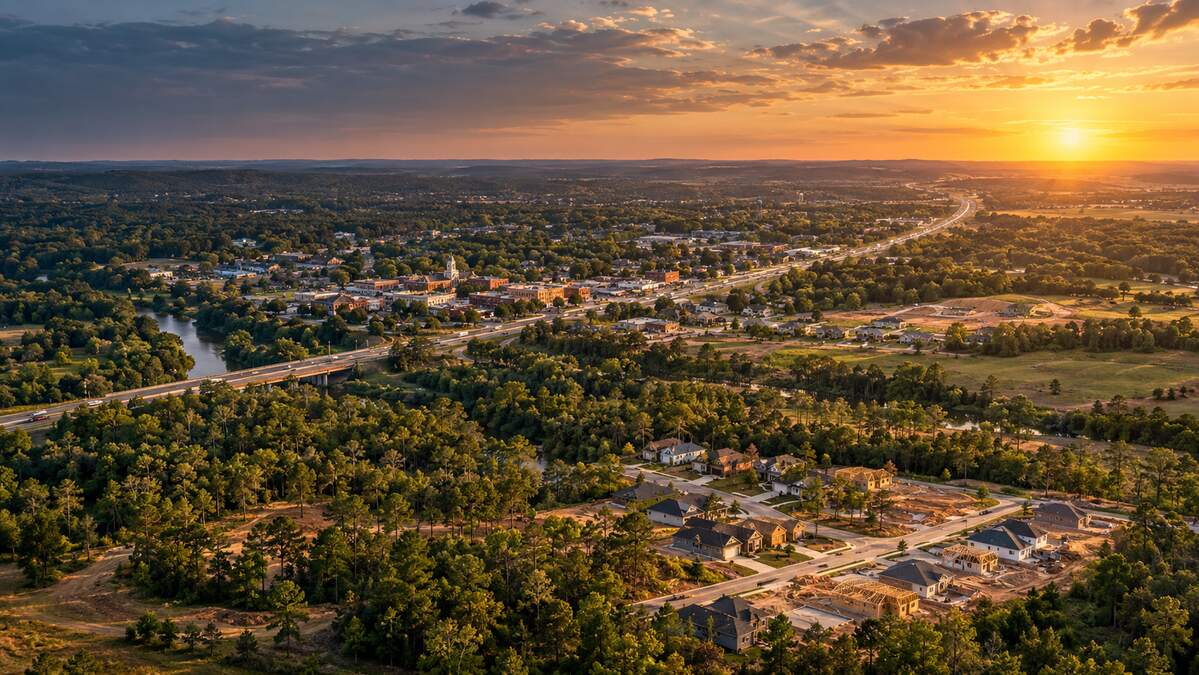
For years, Bastrop, Texas, was best known for its historic downtown, pine forests, riverfront setting, and small-town pace. Those qualities still matter. They are a major part of what attracts people to the area.
But Bastrop County is also developing as an economic center in its own right. New manufacturing facilities, technology projects, data centers, retail plans, and large residential developments are adding another dimension to the local story.
The key question for anyone watching the Bastrop housing market is not simply whether the area is growing. It is whether housing, infrastructure, and local services can keep pace with the jobs and investment arriving across the county.
Major employers are putting down roots in Bastrop County
The Bastrop Economic Development Corporation’s current project tracker lists projects at different stages, from completed facilities to planned expansions.
SpaceX and Starlink are listed as expanding their Bastrop facility by more than one million square feet, with an anticipated investment above $280 million and approximately 400 additional jobs. LS Electric has opened a North American production facility and technical center in Bastrop. The initial facility is about 58,925 square feet and supports 50 workers; the EDC lists further investment and workforce expansion plans over the next five years.
The EDC also lists Acutronic’s planned jet-engine and micro-turbine manufacturing facility as a coming project, with at least 50 jobs expected. Other developments on the tracker include manufacturing and entertainment projects at varying stages.
These projects can create demand for engineers, technicians, manufacturing workers, managers, contractors, and local service businesses. As jobs become operational, housing becomes part of the economic-development picture.
Data centers add another layer of investment
Bastrop County is also attracting large-scale data-center investment. EdgeConneX’s proposed Cedar Creek campus has been reported as a roughly $1.4 billion project, and the Bastrop EDC includes the development in its project information.
Data centers do not employ the same number of people as a large factory, but they can generate construction work, specialized employment, utility investment, and demand for contractors. Their presence also reflects the region’s growing role in technology and infrastructure.
Economic growth reaches beyond the parcel where a company builds. It can affect roads, utilities, service businesses, nearby land, and the places where employees choose to live.
Sendero and the SH 71 corridor are changing
The next phase of Bastrop’s growth is especially visible along State Highway 71. Sendero, near SH 71 and FM 969, is a 75-acre mixed-use development. The EDC now reports that the first phase, Alta Trails, is complete, while additional mixed-use plans continue to evolve.
The EDC also points to Burleson Crossing East, Ironwood, and Bastrop West among the developments shaping the corridor. Its reporting describes roughly 500 acres of mixed-use projects planned or underway across a short stretch of SH 71. Project scope and timing can change, so buyers and landowners should confirm the latest status directly with the appropriate sources.
New restaurants and retailers make an area more convenient, while also reflecting a growing customer base. Housing and commercial development can reinforce each other: residents support local businesses, and new businesses can make a community more appealing to future residents.
Over time, that may mean more housing choices, from apartments and townhomes to new-construction homes and properties outside the most concentrated development areas.
Why access to Austin still matters
Bastrop is about 30 miles southeast of downtown Austin, with SH 71 serving as its primary connection to Austin-Bergstrom International Airport, eastern Travis County, and the broader region. Bastrop EDC’s current location information describes the airport as approximately 20 minutes away and downtown Austin as about 30 minutes under favorable conditions. Actual travel times depend on the starting point, traffic, and time of day.
TxDOT is planning and building improvements along the SH 71 East Corridor in response to growth and higher traffic volumes. The Tucker Hill Lane project includes a new overpass, frontage roads, and improved bicycle and pedestrian accommodations, with completion anticipated in fall 2028. TxDOT’s project information lists a January 2027 letting for Pope Bend Road and a proposed 2030 letting for FM 1209; schedules may change.
Transportation projects do not remove congestion overnight, but they show that agencies are planning for a larger population and heavier traffic than the area has historically experienced.
What growth could mean for the Bastrop housing market
When employment, infrastructure, and commercial development expand at the same time, housing needs can become more varied. Some new residents may move for jobs in technology, manufacturing, construction, healthcare, education, or management. Others may already work in Austin or along the eastern employment corridors and want more space or a different pace of life.
A growing employment base can call for a range of options: rental apartments, entry-level homes, workforce housing, move-up properties, executive homes, and acreage. That creates opportunities and challenges for builders, developers, investors, landowners, and local officials.
Growth also needs to be evaluated carefully. Water supply, wastewater capacity, roads, schools, emergency services, taxes, floodplain conditions, and utility availability all matter. A parcel that looks promising on a map can have very different potential depending on access, water, septic limitations, drainage, and applicable regulations.
That is especially important in Bastrop County, where the market includes both subdivisions and rural properties. Buyers considering land should verify the survey, legal access, utilities, floodplain information, deed restrictions, and development feasibility before relying on a future-growth story.
About the author
Carson Morgan is a Central Texas REALTOR® with New Hope Realty Group, serving buyers, sellers, landowners, and investors throughout the Bastrop–Austin corridor and the Highland Lakes. A real estate investor as well as an active REALTOR®, Carson combines market analysis with hands-on experience in residential property, land, and investment real estate. He holds the Graduate, REALTOR® Institute (GRI) and Pricing Strategy Advisor (PSA) designations and is licensed in Texas under TREC #774484.
Bastrop’s next chapter will be defined by balance
Bastrop is not simply becoming another Austin suburb. Its appeal comes from a mix of economic opportunity and a lifestyle that remains distinct from the urban core. The county offers proximity to Austin, SH 71 access, nearby airport connections, a historic identity, and a slower pace, while companies and developers bring new jobs, housing, services, and infrastructure commitments.
The challenge will be managing growth responsibly and preserving the qualities that made the area attractive in the first place. For buyers, sellers, landowners, and investors, Bastrop is a market to watch as the region evolves from a primarily residential alternative into a more complete economic community.
Research references: Bastrop EDC project tracker; Bastrop EDC location advantages; Bastrop EDC on SH 71 corridor growth; TxDOT SH 71 East Corridor projects.
Project announcements, investment figures, job counts, and timelines can change. Verify current conditions and property-specific feasibility before making decisions.